

This audio blog is on alternative hanging solutions and how the tactile quality of some printed artworks changes the viewers relationship to the art. Give a listen!!


Links:
This audio blog is on alternative hanging solutions and how the tactile quality of some printed artworks changes the viewers relationship to the art. Give a listen!!
Links:
 The audio portion of this post contains my thoughts and test information on the following papers:
Gamut projections of tested papers in Chromix Color Think.
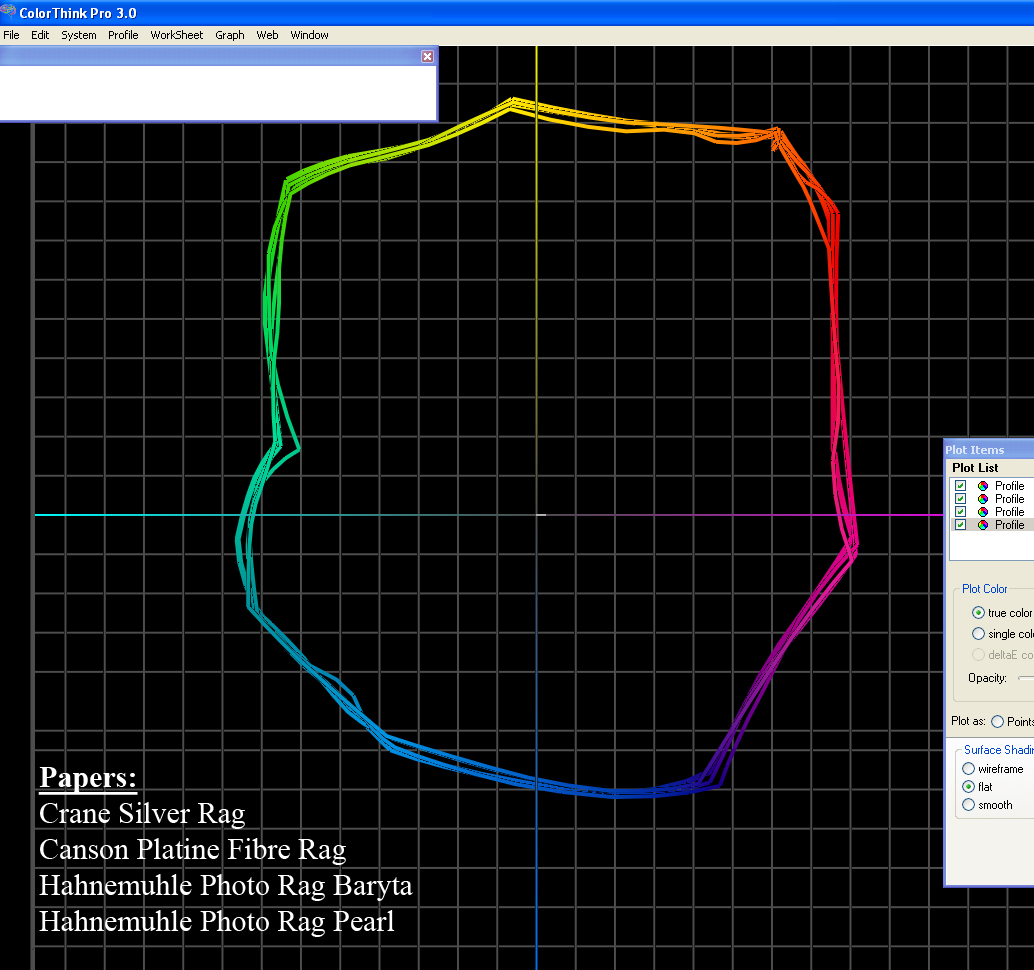
All tests were done on the Epson 9900 using RIP and profiling software by Ergosoft.
Bad batch numbers for Hahnemuhle Photo Rag Baryta 315 gsm:
Note: As I mentioned in the audio portion of this post the new batch of paper supplied to me by Hahnemuhle is perfect and the issue of the black specs has now been corrected from what I can see. I was informed that the issue was “fixed” back in May/ June but unfortunately the bad stock does still exist so check before you buy!
This audio blog focuses on a proposed French law that would require all Photoshop manipulated images of a person to carry a warning label- give a listen. One quick note, in the audio I say that taking two aspirins and eating a banana on one foot will make you 6 inches taller… I meant to say will not.
Link to Article on French Law:
Click on the audio logo to listen to this 10 minute discussion on my favorite films both black and white and color and which developer combo I use at Indian Hill Imageworks for the vast majority of my artworks.
Click on the audio blog logo to listen to a discussion on making one of one photographic prints.
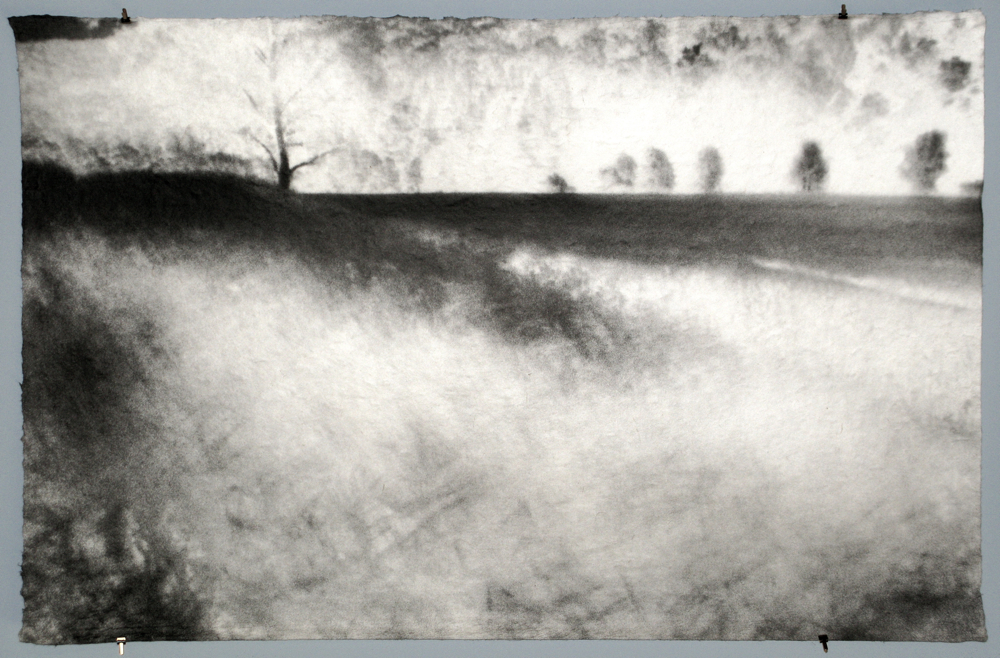
New Artwork form my upcoming show at Indian Hill Imageworks, Opening October 9 from 5-7 pm.

A quick audio blog on how our expectations of a perfect print surface has changed from traditional wet darkroom spotted prints to todays digital prints. Click on the audioblog logo to listen…
Note on image: I use my hand to adjust the brush tip on my spotting brush to a perfect point and to make sure that the flow of dye is perfect.
TIP: If you want to try to spot a digital print, one suggestion is to save the left over ink in your catridges and use them for spotting instead of traditional spotting dyes.
There are two parts to this post: first an HD video for fun followed by an 8 minute thought-provoking discussion on the “need” to archive film in the hybrid workflow- click on the Audio Logo to listen…
Click on the Audio Blog Logo to listen to this 4 minute audio by Stephen Schaub.
Below is a perfect example of old plus new… the new Lomo Fuji Instax Mini back, which is designed to fit the new Lomo Diana F+ (nice but a bit too sharp for my taste)… but with a bit of work (about 2 hours) it fits the vintage Diana Camera and Diana clone cameras perfectly and has a resulting look and feel that is amazing!!… more on that soon.


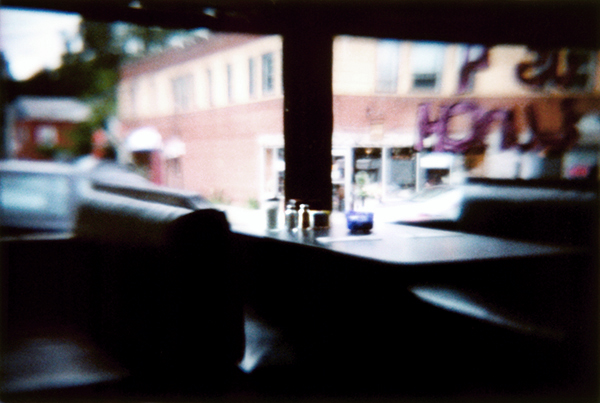
 This is part one in a multi-part article on stand development and semi-stand development (BW) for the purposes of scanning. I have been spending much time looking at different dilutions, different agitation techniques, different recipies and I have come up with a good working solution for my tested films that produces perfect results every time.
To listen to the audioblog portion of this post … just click on the Audio Logo.
Many of you know I really like Diafine Developer (I have written several articles here on its fantastic qualities for scanning)… the techniques I am about to outline have many of the advantages of Diafine but with finer grain and better highlight separation.
Before we get started, here is a shopping list if you want to try this technique for yourself:
Film: Fuji Acros or Kodak TMY-2 (New TMAX 400)
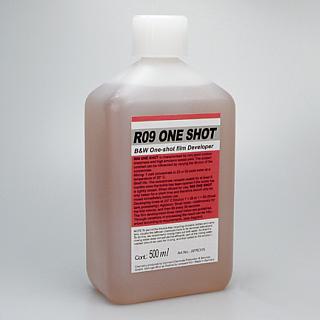
R09 “One Shot” Developer (Rodinal Replacement)
Kodak Xtol Developer
Ascorbic Acid
Borax
Or you can use 20 Mule Team Borax found at most Supermarkets.
Distilled Water (a few gallons)
Plus you will need, of course, your standard darkroom chems: stop bath, fixer, and hypo.
Stay tuned for Part 2 in two days!
Viva la Revolution- Stephen
Ethical Note: I do not endorse any vendor of photographic material over another. The links provided above are just an easy source to find the materials needed but by no means are the best or only source.
How’s that for a catchy title? The image below represents- as I mentioned in my audio blog journal from Italy – a situation where I had to work though some difficult restrictions but in the end was rewarded with an image I really like. The artwork was made in the Vatican Museum which is really beautiful and amazing, but as you can imagine very strict with rules about what and how you can photograph. When we entered the “room of heads” (my name) I was really drawn to the layers of history and how everything seemed to merge into an ordered historic chaos. This was also a situation where the macro feature of the XA 4 really came in handy!
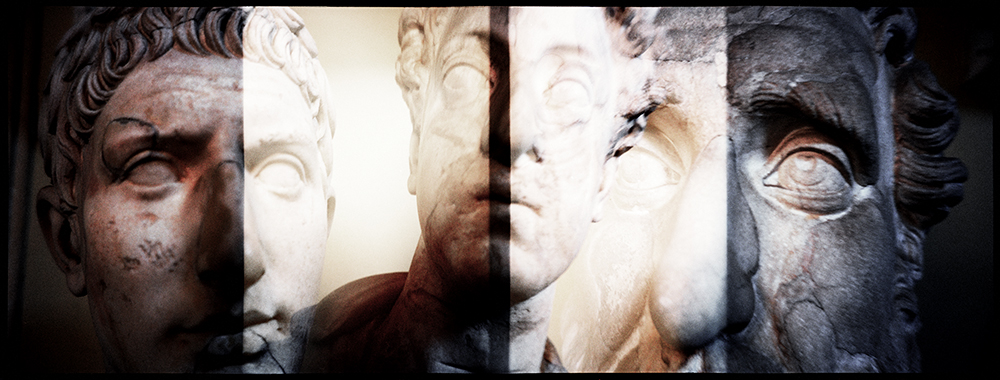
Caligula and Friends
Vatican Museum, 2009
Triple Overlapping Frame Panoramic Technique
Capture: Olympus XA 4, Kodak Ektar 100
Image Size: 9″ x 25″, Printed on Fabriano Rough 640 GSM
Copyright Stephen Schaub 2009
 Figital Revolution