So my testing has confirmed that with the 1:1 dilution of Diafine in a JOBO at Rotation P you need to extend your development time to 6 minutes in part A and part B and also run at a temp around 25 C. If you choose not to, you will find that films like 400TX die after about EI 800 (shadows get a bit too thin for me) which is about a stop lower than is expected with the Diafine/ 400TX combo. If you only want box speed to say 800 with 400TX then the standard 3 minutes in A and B is fine.
So today I ran a test to compare 1:1 and full strength Diafine also in a JOBO. Density as you would expect is a tad bit higher at the full strength but not by a lot… again I am extending the time to 6 min in A and 6 min in B. The contrast of the full strength is also a tad bit higher, but nothing a good scanner could not work with…. but the 1:1 is soooo nice.
My advice…. Diafine 1:1 at 25 C for 6 min in A and 6 min in B, rotation setting P. (Note: 1:1 with Diafine is a one shot developer!)
With regards to high speed films, Kodak TX400 works out to a usable E.I. range 1:1 (6 min A and B) from about 200/400-1600 with 3200 somewhat usable…. maybe! Ilford Delta 3200 is amazing with this developer and is nice from about 100/200 – 1600 with 3200 also quite usable in a pinch ( note: you have to love grain to love this film)! The now killed Kodak P3200 is still undergoing tests as it is still around in good supply and it looks like it will have a very solid 3200 but much more grain than the Ilford… which could be nice! I love grain!!
Ilford Delta 3200 and Kodak 400TX both Diafine Developer at 1600.
The Kodak 400TX has nice grain but wow the Ilford is just stunning…. The Ilford is only long term bet as of now – much lower contrast and very easy to scan across a wide range of EI. All the scans above are 100% crops from a very large 35mm scans at 3000 dpi on my Imacon Scanner (I decided not to do 6300 dpi on the scan just to save time and sharpening is off on the scanner, -120 setting).
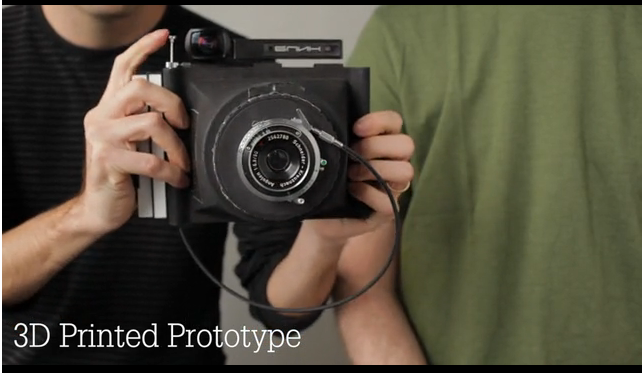
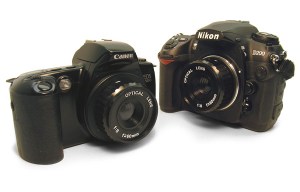
Of course not the first camera of this kind and I do worry about the build quality BUT at $100 for the camera (lens and accessories are additional $$$$$$) it is quite interesting.
As I said others options do exist and many with a better build quality and additional options, however, anything to keep film and LF alive is cool by me! Ive been shooting a lot of LF in the last few months… but more on that and a review of some LF films and processing options in a few weeks.
My wife Eve and I watched this movie last night on Photographer Bill Cunningham… it is available on Netflix Streaming and I am sure other venues… very enjoyable and yes he shoots film!
Click on the Inside Analog Photo LOGO to listen to an interview with yours truly on stop your crying and start your buying.
Interview by:
Scott Sheppard
Executive Producer/Anchor
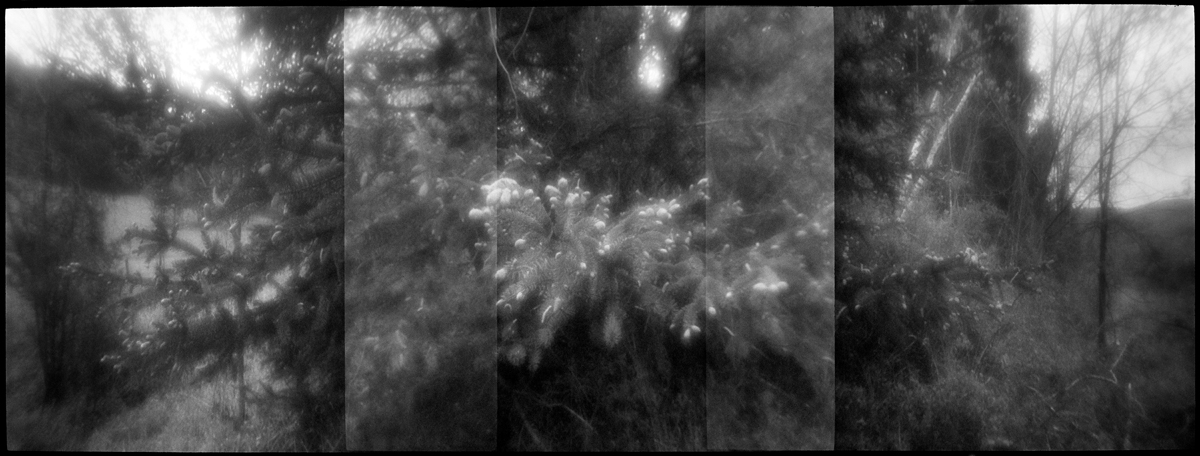
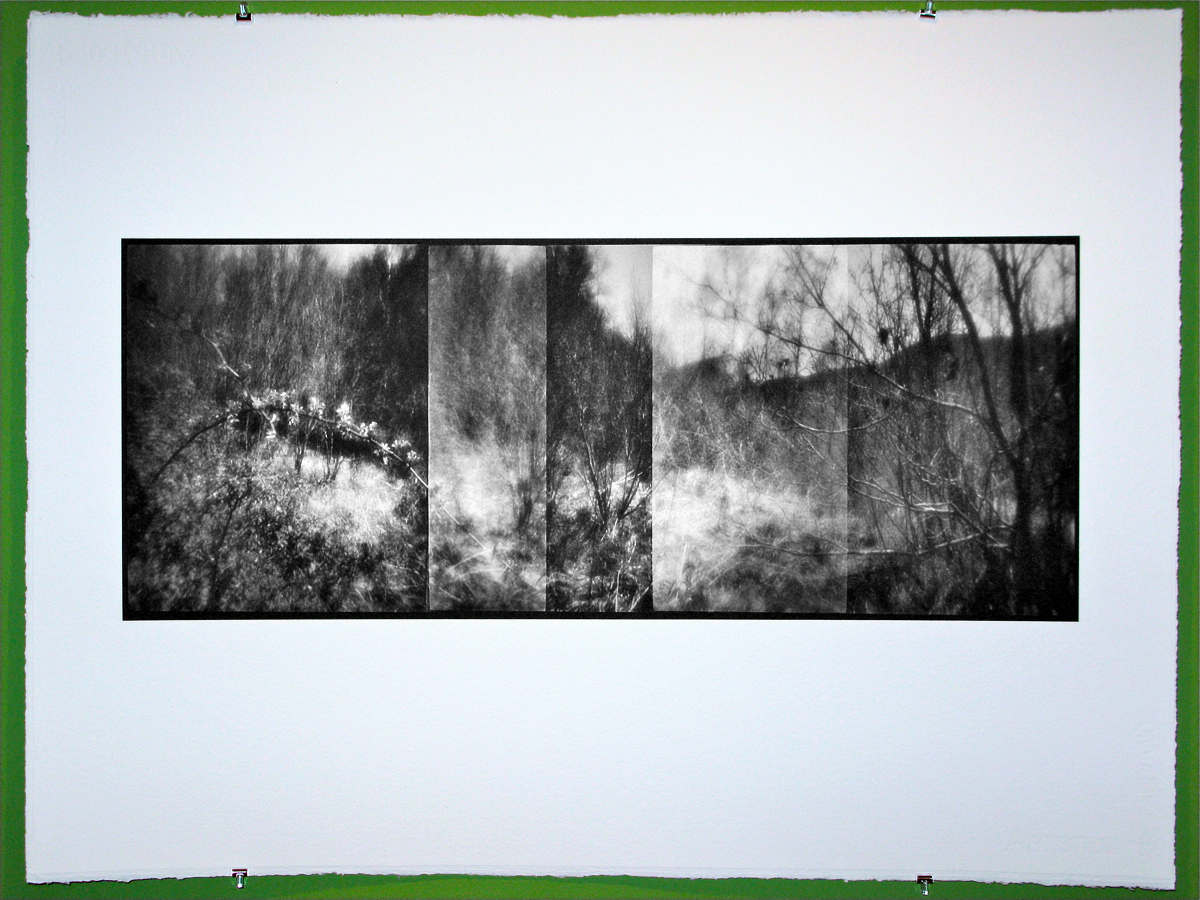
The final installment of this series provides information on all films tested, thoughts on Zone Plate and Pinhole as it relates to these films and observations and conclusion on this process. The audio portion can be heard by clicking on the Audio logo: note the audio portion is around 16 minutes. Pine, Vermont. 2009
28mm Zone Plate on Leica M7
Overlapping Frame Panoramic Technique (3X)
Film: Kodak TMY-2 (Tmax 400) at an EI of 1600, processed in Xtol Developer.
Printed on Fabriano 640 gsm, edition size one.
Copyright Stephen Schaub 2009
Spring Blossom, Vermont. 2009
28mm Zone Plate on Leica M7
Overlapping Frame Panoramic Technique (3X)
Long Hand Held Exposure, 30 sec +/-
Film: Kodak Ektar 100Printed on Fabriano 640 gsm, edition size one.
Copyright Stephen Schaub 2009
Field Edge, Indian Hill, Vermont. 2009
28mm Zone Plate on Leica M7
Overlapping Frame Panoramic Technique (3x)
Long Hand Held Exposure, 20 sec +/-
Film: Kodak Ektar 100Printed on Fabriano 640 gsm, edition size one.
Copyright Stephen Schaub 2009
Part of my ongoing creative exploration of Zone Plate and Pinhole photography has entered a new area… high speed film. Most applications of Pinhole or Zone Plate photography require the use of a tripod or some sort of support device but that does not fit with my current shooting style SO I have just run tests of Ilford Delta 3200 and Kodak P3200 in a variety of different developers from an EI of 3200 – 25,000 to see if it would be possible to hand hold exposures under a variety of common lighting situations and get a negative that-when-scanned would have all of the expressive grey tonality I need with contrast in check… the answer is Yes! The best film for pinhole and zone plate high speed applications in my opinion would be the Kodak P3200 at 3200 – 6400. The sample images below are just a very quick test done at the end of the day in rainy overcast very flat light… the image on the left is a 28mm F32 zone plate on my Leica M7, the image on the right is a 28mm F151 Pinhole also on my Leica M7… both hand-held at shutter speeds over 1/30th even in this dismal low light… shot at an EI of 6400. The cropped image is a 5″ x 5″ example section of the pinhole image scaled to 20″ x 30″ … remember this is an EI of 6400 shot through a pinhole. I think the visual quality is amazing and I plan on shooting this afternoon and posting a fuller series of articles starting in a few days with the “secret” developer info as well as thoughts on working with pinhole and zone plate with high speed films on a variety of different cameras. Just a quick note- no noise reduction or sharpening has been applied to any image and all images are dry scans on my Imacon Scanner.
Left Zone Plate, Right Pinhole5" x 5" Crop of a 20" x 30" Print.
The sun has just come out (lots of rain here in VT this time of year) so I am off to shoot!
Viva la Revolution- Stephen UPDATE: Ok so most of the day has passed and I have managed to shoot two rolls of the Kodak P3200 at and EI of 6400 (the sun was out for exactly 2 hours!) and just finished processing them… they look fantastic! My exposures were for the most part using the pinhole (f 151) at shutter speeds ranging from 1/60 to 1/15 on my M7. I will post images sometime tomorrow…
Today I did finish my client work first and still had time to scan and complete 2 more images from my roll from yesterday…
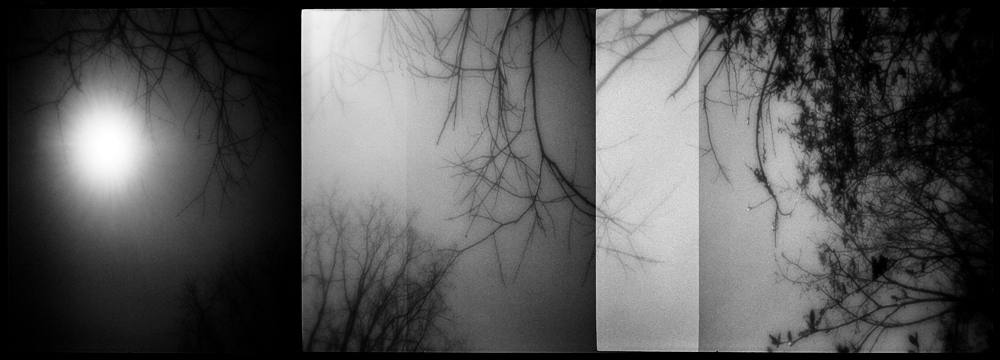
In The Willow, Vermont. 2009Dark Sky, Spring, Vermont. 2009
Viva la Revolution- Stephen
Tech Stuff:
Both images were shot with a Leica M7 with a 28mm F32 Zone Plate on Ilford XP2 Super at an EI of 800- in camera overlapping frame panoramic technique, 3X.
Scanned on an Imacon Scanner
Printed on the d’Vinci Printer as a d’Vinci Noir Print.
Many of you have been asking for some insight beyond the technical- more of “A Day in the Life” creative -type stuff, SO… here is a good example of how things can happen around here:
Ok, yesterday after posting the video on Focus and DOF here on Figital Revolution I was searching the web and came across a great new attachment which allows youto connect a Holga lens to a Canon or Nikon with precision… here is a link. It is made by S.K. Grimes who I have done some work with in the past and I am sure the construction is spot-on. I decided to call Adam at S.K. Grimes and ask about making a device like this for my Leica M. I love the Holga (my second book is all Holga work) and thought this could be a great side project. I also found online a home-made attachment / modification for the Holga lens on the Leica M, LINK, but I would prefer the precision of the S.K. Grimes version if I have a choice.
Then I got to thinking about my Through A Glass Darklyartworks and what I liked about them and remembered that last year I had done some work with Zone Plates on several different camera systems and that I had purchased a 28mm F32 Zone Plate for my Leica M7… so then, of course, I had to go find it. After digging through a few drawers in my studio it ultimately surfaced so now I only needed to find some fast film because at F32, 100 speed film would be out of the question for hand-held exposures (maybe). So, yes, I found a roll (one, lonely little roll!) of XP2 Super which I knew had enough exposure latitude to rate with an EI of 800 or even 1250 if needed (I settled on 800).
Finally I decided to shoot a test roll around my yard here in Vermont. I was really curious to see if I could fuse the look and feel of my Through A Glass Darkly Artworks, the Zone Plate, the Overlapping-Frame Panoramic Technique AND my most recent A New Eden Artworks into one creative stew. About 30 minutes later I was off to my favorite lab Phototec, in Rutland Vermont, to have the C41 film processed and-equally importantly although perhaps not so much creatively- get my Prius’s oil changed. One hour later my car was running fine and the negatives were dry.
Zone Plate Overlapping Frame Panoramic Technique
I was surprised at how much I really liked them… really, really liked them! (This is not the way ALL my brilliant ideas go, you know.) So I had to hurry back to the studio, fire up the Imacon and run a test scan. After a bit of thought on how to compensate for the very low contrast negatives I came up with a good scanner setting and set to work on the file. An hour or so later the image was finished and I really liked how it looked on the screen. Buuuuuut as I had chosen to shoot B&W film and my current favorite art paper (hand-coated Fabriano, 640 gsm) only has an icc. for color and not the required K4 linearization for black and white printing on my d’Vinci Printer it was time- oh yes!- to make the linearization. So about an hour after THAT the linearization was complete and I was all set to print. I had several sheets of paper coated both rough and cold press (luckily left over from a client’s job from last week) but I ultimately decided to go with the cold press as the smoother surface texture would, perhaps, help define the soft elements of the image better than the rough would (I plan to run a test soon on this to be sure!)
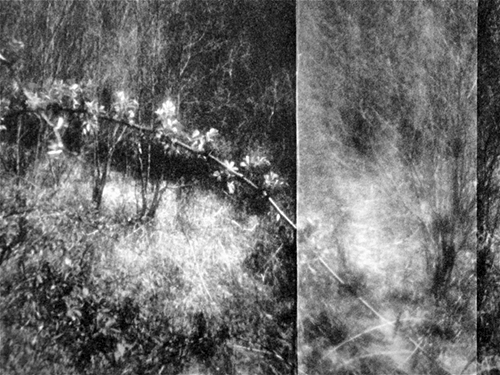
Surface Detail of Final Print on Fabriano Cold Press HC
Conclusion… I really liked the image and possible new direction for these artworks- hooray! Did I get my work for client’s done today? No! Is it ultimately worth it, in the end, to go with the “art attack” when it strikes? Always!! You can’t do it all the time, BUT inspiration is too valuable not to follow up whenever humanly possible. And if you can get your car ready for another couple of thousand miles of exploring at the same time… even better.
Next, I think I will try this in color using the Fuji 800Z. And as I always say… experimentation is key! Stay tuned.
Exposure Index- “EI”- is your personal speed setting for a particular film and developer combo that in most cases is different than the manufacturers posted ISO or ASA data (lots of reasons for this difference) and it reflects a photographer’s specific film requirements with regards to shadow and highlight detail, contrast, grain, etc… Many photographers do extensive testing to determine the best EI for a particular film and developer combo but in the end most photographers settle for a single EI and developer time for a particular film. An example would be- “I shoot Kodak TX at an EI of 1250 and process in Diafine 3+3 at 70F.”
Now for the Diafine Twist:
That tested EI is not the “only perfect EI” but rather just one possible working EI when using Diafine Developer. For example, I have determined that TX processed in Diafine at 3+3 has a USABLE EI range of 400-1250/ 1600…that means that I can rate it at 400 or I can rate it at 1250 if I need to or I can rate it at any in between EI based on subject exposure requirements- there is enough latitude with regards to exposure and development with TX and Diafine that both of these EI are possible for scanning purposes and produce brillant negatives…even one shot right after another on the same roll at a different EI, each would get the same processing time in Diafine– it is like working with the very forgiving Ilford XP2 Super which can handle a range from EI 100-800 (C-41 film) but with real B&W film! (Note: I love XP2 Super but it is a very different looking beast than conventional B&W film.) With a “normal” developer, say D-76, you would need to increase or decrease your development time or temp or both if you changed your EI beyond half a stop with most black and white films.
So here are a few films I use with their USABLE EI range based on my testing. (NOTE: all USABLE EI listed are for Diafine Processing as outlined here on Figital Revolution.)
TX: 400-1250/ 1600 (3+3 at 70F)
125PX: 125-400 (3+3 at 70F)
Fuji Acros: 100-200 (4.5 + 4.5 at 70F)
TMY-2: 400-640 (3+3 at 70F)
FP4+: 100-225 (3+3 at 70F)
Final Thought…why would you want to have a different EI for the same film or know the EI range for a particular film? The answer is flexability (how much can I over or under expose and still get a good negative)- with this approach and knowledge let’s say, for example, I am working with a film like Kodak TX-just load a roll in the morning and start shooting and adjust your USABLE or “flexible” EI as the day and lighting change… when you’re done just process the whole roll with your normal Diafine processing time and scan away! The results are consistantly USABLE and amazing.









 Figital Revolution
