What is YOUR Usable EI – Exposure Index?

First a quick bit of background info:

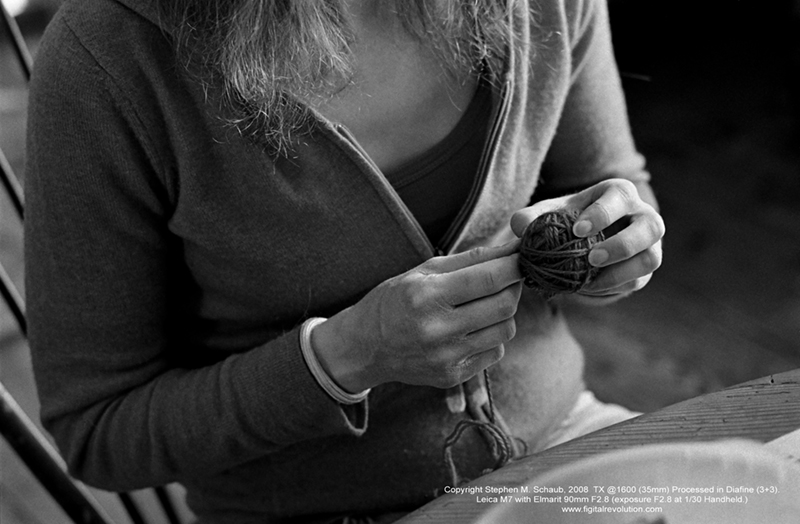
Exposure Index- “EI”- is your personal speed setting for a particular film and developer combo that in most cases is different than the manufacturers posted ISO or ASA data (lots of reasons for this difference) and it reflects a photographer’s specific film requirements with regards to shadow and highlight detail, contrast, grain, etc… Many photographers do extensive testing to determine the best EI for a particular film and developer combo but in the end most photographers settle for a single EI and developer time for a particular film. An example would be- “I shoot Kodak TX at an EI of 1250 and process in Diafine 3+3 at 70F.”

Now for the Diafine Twist:

That tested EI is not the “only perfect EI” but rather just one possible working EI when using Diafine Developer. For example, I have determined that TX processed in Diafine at 3+3 has a USABLE EI range of 400-1250/ 1600…that means that I can rate it at 400 or I can rate it at 1250 if I need to or I can rate it at any in between EI based on subject exposure requirements- there is enough latitude with regards to exposure and development with TX and Diafine that both of these EI are possible for scanning purposes and produce brillant negatives…even one shot right after another on the same roll at a different EI, each would get the same processing time in Diafine– it is like working with the very forgiving Ilford XP2 Super which can handle a range from EI 100-800 (C-41 film) but with real B&W film! (Note: I love XP2 Super but it is a very different looking beast than conventional B&W film.)  With a “normal” developer, say D-76, you would need to increase or decrease your development time or temp or both if you changed your EI beyond half a stop with most black and white films.

So here are a few films I use with their USABLE EI range based on my testing. (NOTE: all USABLE EI listed are for Diafine Processing as outlined here on Figital Revolution.)

  • TX: 400-1250/ 1600 (3+3 at 70F)
  • 125PX: 125-400 (3+3 at 70F)
  • Fuji Acros: 100-200 (4.5 + 4.5 at 70F)
  • TMY-2: 400-640 (3+3 at 70F)
  • FP4+: 100-225 (3+3 at 70F)

Final Thought…why would you want to have a different EI for the same film or know the EI range for a particular film? The answer is flexability (how much can I over or under expose and still get a good negative)- with this approach and knowledge let’s say, for example, I am working with a film like Kodak TX-just load a roll in the morning and start shooting and adjust your USABLE or “flexible” EI as the day and lighting change… when you’re done just process the whole roll with your normal Diafine processing time and scan away! The results are consistantly USABLE and amazing.

28mm Zone Plate meets the M7 and Diafine Developer

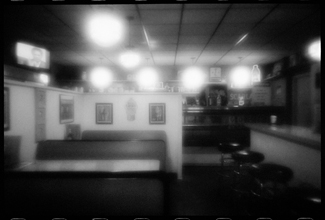
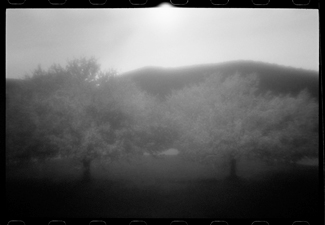
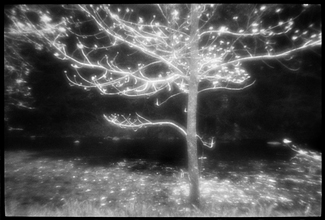
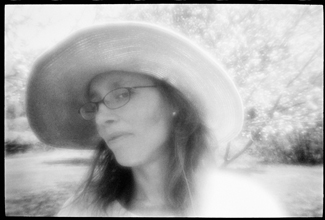
Some years ago I did extensive work with pinholes, Zone plates and Holga camera systems, specifically for my Through A Glass Darkly artworks and book. Recently I decided to give a Zone Plate a try on my Leica M7 (it is a 28mm f/32 Zone Plate I purchased from Pinhole Resources) and TX processed as I have already outlined here on the Figital Revolution using Diafine Developer. It seems to me that this combo of TX/ Diafine/ Zone Plate and Leica M are a perfect combo. The TX and Diafine Developer really help control the Zone Plate with regards to contrast and it also gives me a high enough EI to make hand held shots very possible (my usable range for TX in Diafine is 400-1600). The M7, or really any rangefinder camera system is nice as the image view is not reduced (illumination) by looking through the Zone Plate as would be the case with an SLR (of course this means that you will have to visualize your final image as none of the Zone Plate qualities will be visible until you process your film assuming you’re using a film rangefinder). Of course digital capture would give you instant feed back (did this a few years ago in the American Southwest) but I just love the look of this combo. Scans were done in house at Indian Hill Imageworks on our Imacon Scanner, wet mount at 3200 optical dpi- a few resulting images are below from my first roll…
 

For more information on using a Zone Plate or for that matter what is a Zone Plate check out the links below.

Viva la Revolution!

OCP – Obsessive Compulsive Photographer

Every photographer I know is at least a bit OCD…that is to say we worry and test our materials far more than any other art form- and perhaps even far more than we really need to. This audio blog attempts to provide a bit of breather room and hopefully some ideas on how to control your OCP (obsessive complusive photographic disorder) before it is too late!

Experimentation is Key!

Ever wonder where the articles and ideas for the articles on the Figital Revolution come from? Tired of your current process or working method and are looking for something new or a new approach. This audio blog provides high energy ideas on suggestions on how to jump start your creative process and redefine yourself as a photographer.

Resource link mentioned in Audio:

End of an Era…The Stinehour Press is Closing!

Stephen Schaub, The Leader!I find this post very disturbing to write and a sad reflection on our current economic situation here in the US, as well as an unfortunate look at the trend in book publishing to find the cheapest and “good enough” printing press for the production of Fine Art  Books. Where are most “fine art” books printed now?…China! That is not to say that good books can not and have not been printed in China, but we all know there is a huge difference between a  book printed on a cookie cutter press and one printed at a true fine art printing press.
I personally have been very fortunate in my career thus far, having my first book printed at the Stinehour Press in Lunenburg, Vermont and my second book at the Salto Press in Belgium. Both of these presses represent the pinnacle of printing quality (which translates into options for the artist) yet now it seems that the Stinehour Press will be no more in just a few months. 

Founded in 1952 and employing over 21 employees the Stinehour Press had won numerous awards for printing excellence and it’s collection of printed books and materials reads like a list of luminaries in the field of Art with a very large capitol A. Stephen Stinehour, who I consider a personal friend, left the press several years ago to pursue other printing projects, yet I know he finds the closing of the Stinehour Press- which was founded by his father- a sad statement on the currect position of the printing industry in the US.

In our quest to get to get the most for our dollar (or Euro or whatever) many people seem to lose sight that in that process of “how low can you go” a lot is lost… and once it is gone it is gone forever. In the “new” industry of Giclee Fine Art Printing I can remember only a few years back where how cheap and how fast you could print was the driving force for marketing products and services. Fade-out/fade-in 5 years and most of the get-rich-quick printing operations are gone, dying, or consolidated because you can only cut costs so far and most of these technologies at the end of the day are still quite expensive to run and upgrade. It seems correct to me that a great print deserves a fair price/competitive price…but you have to compare apples with apples. Also remember that cuts in cost almost always come at the expense of quality and workers pay or health benefits…you know the complaint and I’m sure you hear it everyday on the news or in your own community.  Continue reading “End of an Era…The Stinehour Press is Closing!”

Sharpness and Grain…Diafine Processed Films Compared!

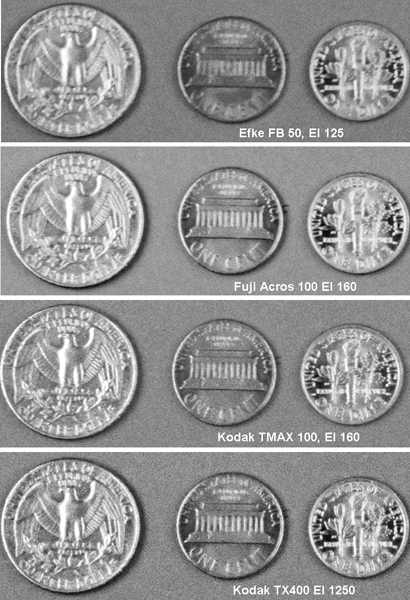
Here is something which is pretty straightforward and yet VERY interesting….a simple test target made by me to determine film sharpness and grain when processed in Diafine:

  • Lens to subject distance 55″
  • Leica M7 with a 90mm Elmarit F2.8 shot at F8
  • On a tripod with cable release.
  • Lighting, Wescott Spider Lights (5500 K)
  • All scan done on an Imacon Scanner (Wet Mount) 6300 optical dpi, 16 Bit.

Just click on the images below and check out the enlargement…the full size image (these are 35mm scanned negatives btw) would be 16″x 25″ at 360 dpi (optical resolution). No sharpening has been applied to the images but I did “try” to make them look as good as possible using levels and a little (I must stress the word little) noise reduction.

So what are your thoughts!?

Diafine Developer and TX…Part 2.5

060 Filter B+W

OK, this is a quickie. I’ve been running some tests here at Indian Hill Imageworks to determine if using contrast filters such as:

  • Light Yellow 021
  • Light Red 090
  • Yellow Green 060

would cause a problem with this awesome film/ developer combo. Answer: NO. I personally like no filter or a ND if I’m shooting in bright light (remember TX in Diafine has an EI of 1250 to 1600 so unless you like F22 at 1/1000th its ND (Neutral Density) or Contrast Filter time!) I love the full gray tones of this film/ developer combo and find the “straight neg” is the easiest to scan and get every bit of tonality.

NOTE: On the Light Red 090 just be very careful with your shadow placement.

NOTE 2: ONLY use good filters…I like B+W and Heliopan…Yes they are expensive but worth it! Here is great resource for an explanation of Filter Flare and other optical stuff!

What, you say?! No sample pictures with this article (horrors)!!???…Go make them yourself you lazy bum, I’m tired! (A joke, of course- I’m never tired!)

My final article in this series on printing and hand coating your own inkjet papers will be out very soon…stay tuned!

Viva la Revolution!! Stephen Schaub

Scanning, Color Mangement and Photoshop…The Diafine and TX Sage…Part 2

As promised here is the next installment in the ongoing exploration of Diafine Developer and TX. In these videos hybrid artist and master printer Stephen Schaub (The Leader) discusses scanning techniques, color management considerations and Photoshop techniques to maximize your Diafine processed TX negatives!! (Please note that due to a time limitation on Youtube the video has been broken into two parts so be sure to watch BOTH videos!!)

Video ONE

Video TWO

Stay tuned for part 3 of the Diafine and TX saga early next week on the Figital Revolution!

Resource Links

Noise Ninja

Pixel Genius (Photo Kit Sharpening Software)

Kami Scanning Supplies

Ergosoft High Fidelity Inkjet RIP Software

Eizo Monitors

Viva la Revolution!!

Processing Black and White Film for Scanning – Diafine and TX!

If you’re like me you’re always on the lookout for a great black and white film/ developer combo for scanning. I’ve tried many different films and developers and then recently stumbled upon the great marriage of Diafine and TX (Kodak Tri-x)…my new standard. Watch the videos below to learn more about this dynamic combination and for tips on proper processing techniques as well as a few quick tips on scanning black and white negatives. Be sure to also check out my sample pictures under the videos to see just how good it is. (Click on the images for a larger view.)

Video:

Please note that due to YouTube 10 minute video limit I had to break this 12 minute discussion into two parts. (Be sure to watch both videos!)

Video 1

Video 2

Example Pictures:

This image illustrates the huge dynamic range possible with TX and Diafine. In this example TX was rated at 1600, 35mm. (Check out that shadow detail!)

TX1600_DynamicRangeExample

This example is TX at 1600 in low flat lighting…the full print size is 16″x24″ and the crop is a 4″x6″ section out of the full image area. Film size: 35mm

This example and the close up represent TX at 1600. The final image size (print) is 16″x24″ and the crop represents a 3″x3″ area of the final image at full size. Remember…this is TX at 1600 in 35mm!!

EveCropAt1600TX35mm16_24print

Processing Information for Tested Films:

Fuji Acros 100 EI 200 70-75 5+5 (Best choice for really big enlargements and where an EI of 200 is ok.)

FP4 EI 200-250 70-75 3+3 (Very nice but I prefer PMK for FP4).
TMY-2 EI 500-640 70-75 3+3 (Very nice combo but I’d stick with Xtol or D76 1:1…see my review of this film here on the Figital Revolution.)

TX EI 1250-1600 70-75 3+3 (My personal favorite and my new everyday film. I also keep an ND filter with me (.9) for the bright afternoon light and just remove it as the day ends so I can shoot this film all day long on my M7 with no worries!)

All chemicals are mixed with distilled water. Processing is done by hand with stainless steel tanks and reels.

I will be posting Part 2 in a few days which will cover my scanning techniques (specific and general) as well as basic file handling. Part 3 (next week) will focus on the final print and have a demo (yes another video) on hand coating your own paper for inkjet. Stay Tuned!!

For a quick audioblog on my printing techniques and my thoughts on tonality just click on this link: A Fear of Gray

All images and video Copyright Stephen M. Schaub 2008

The Final Word – A Rebutal to END ALL Rebutals

Schaub Y StrapIf you spend as much time as I do on the web (drinking espresso) you come across some pretty interesting assertions by photographers from all walks of life. I have posted this audioblog in an effort to ameliorate and perhaps provide a bit of “middle ground” for a conversation between the Luminous Landscape and Ken Rockwell. (To read each original article just click on the links below:)
 

Luminous Landscape Article – Your Camera Does Matter

Ken Rockwell Article – Your Camera Doesn’t Matter

AudioBlog LogoOk, now that you’ve been outraged by the silly, over-the-top claims on all sides, and are searching for some clarity in your photographic life give this audioblog a listen….it’s therapy time. In the end we can and should all get along!