Click on the audio blog logo to listen to this 7 minute discussion on manipulation and how I feel photography should embrace it as a core belief rather than shy away from admitting something that is at the very nature of our medium. First, however, watch the videos below (full screen with your sound turned on if possible).
“Is it a brave new world? Or are we just now admitting something that has always been true: all photography at its core involves some form of manipulation.” -Stephen Schaub, Leader Figital Revolution
First watch the video link below… you only need to watch the first minute or two of the video where Mr. Hayzlett is speaking about film and digital- then click on the audio logo to listen to the discussion…
5″ crop from a 30″ print… do you see my dirty windows?
Crop from a 30″ print… do you see the screen?
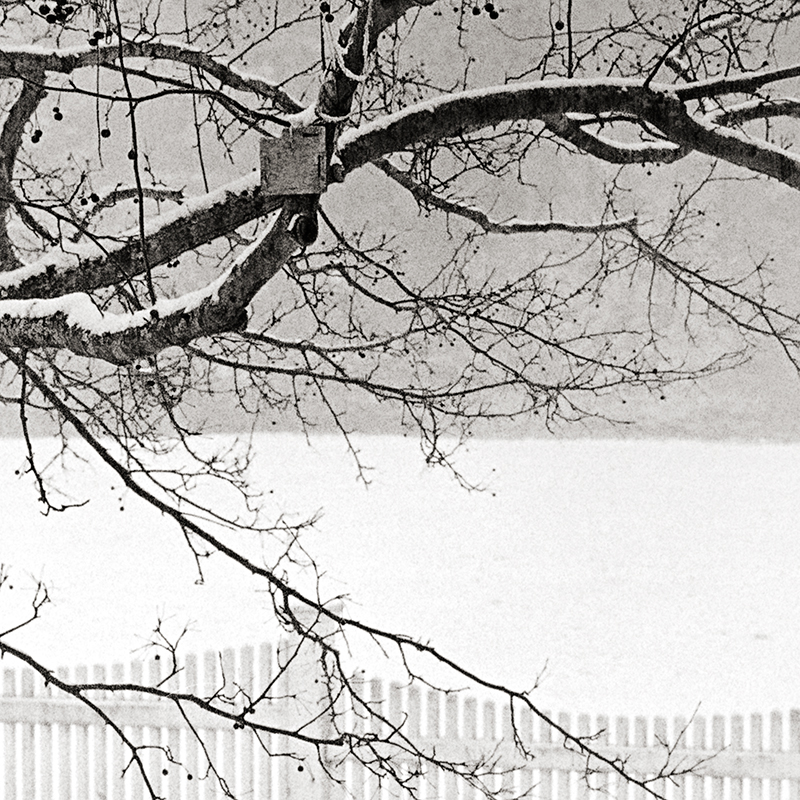
“Normal” Scene.
5″ crop from a 30″ print… yes, it is snowing in the image.
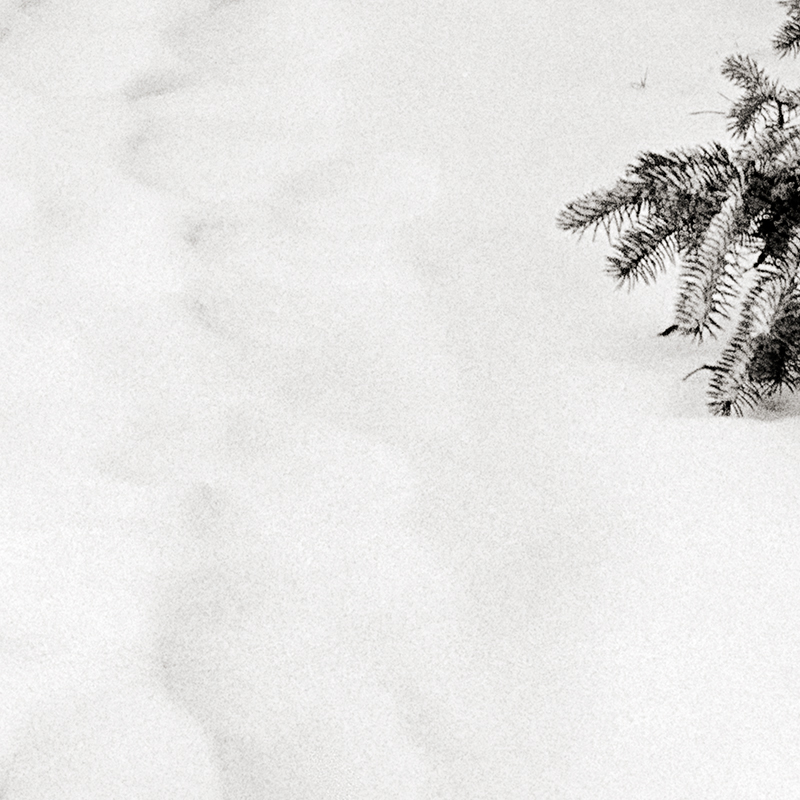
5″ detail crop of a 30″ print… look at the texture in the snow… Zone 8!
Few notes:
Both test images were shot on Kodak TMAX 100 at box speed.
The first test scene was very extreme… Zone 3 on the lower cabinets and the outside snow was Zone 14. The detail images are amazing and I really like how the grain is rendered.
In the second test scene I chose something that had a more “normal” range… deep shadows on the far right bush are Zone 3 and the lightest snow fell on a solid Zone 8… it was snowing during the test shots which is normal for Vermont this time of year, you can see the texture the falling snow makes in the background… the range is quite impressive and very easy to work with.
Both scans were straight scans (Imacon) with no sharpening and no noise reduction applied. In Photoshop my standard contrast adjustments were made with little to no effort. In both cases I had more than enough shadow information and a simple “S” curve did the trick… much like I would do with Diafine processed negatives.
When I compare these negative to the Fuji Acros negatives I find the Acros is a bit softer and the highlights tend to get very dense whereas the Kodak Tmax 100 negatives are a bit thinner looking but have full shadow detail and very controlled highlight density. The grain on the Tmax 100 in my opinion is a bit sharper than the Acros but both look really nice.
Both test images were shot on my 1960 Rollei TLR “F” (120). The first test image was at F5.6 at 1/4 sec and the second image was F11 at 1/30th.
How’s that for a great way to start the New Year!
Caffenol C Note:
I am working on a new book which will outline the technique I use for processing with Caffenol C and also give a starting direction for scanning and Photoshop adjustments to these negatives. I hope to finish sometime this winter so stay tuned.
Click on the audio blog logo to listen to this 14 minute review of the last 10 years of photography from my perspective as a hybrid artist and where the industry is possibly going in the next decade.
To everyone I wish a safe and happy New Years and stay tuned for a new post in a few days.
This was a specific custom request I had for my Cuboid as I do all of my pinhole shooting hand held… I am off to get it installed today! Just click the play icon to watch it in action.
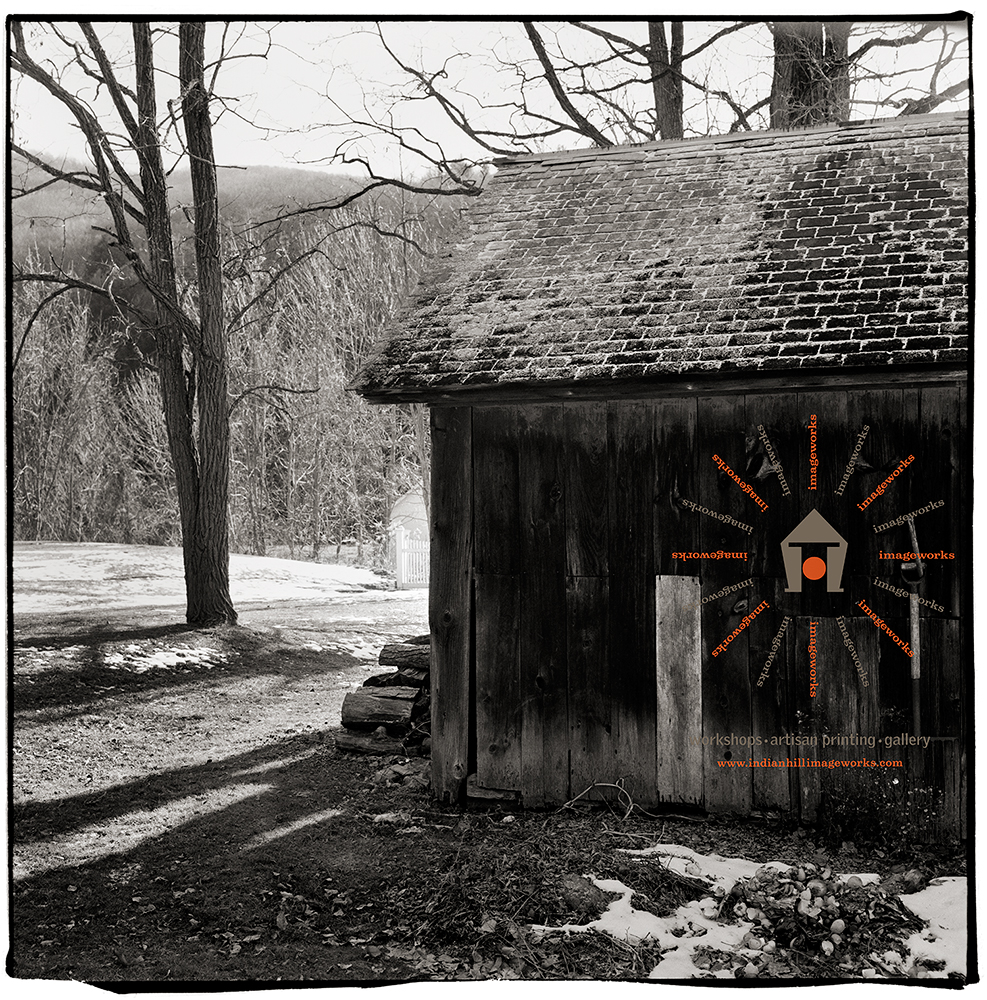
Here is a test image that I shot this afternoon with a huge dynamic range … it was 5 degrees Fahrenheit- but anything for art! The image was made with my Rollei TLR on Fuji Acros at box speed, processed in Caffenol C. So, what do I see?… a very nice range of tones, very sharp and nicely defined grain. The dark barn boards were metered for Zone 3 and the white patch of snow in the background fell around Zone 9.5 and yes there is tone… the sky in between the branches is a Zone 7.5. Overall I am very happy with the results and the level of control this unconventional developer provided for such a difficult shot. The scan was done on my Imacon… in Photoshop I did some standard black point and white point adjustments as well as a bit of a boost to contrast but not much more. The negative has very much a Diafine quality with regards to the required photoshop “S” curve to increase contrast and is very neutral in that it could easily be adjust to many different visual qualities. Interesting…
Fuji Acros 120 Processed in Caffenol CDetail Fuji Acros 120 Processed in Caffenol C
This detail crop would be from a 30″ x 30″ print and would represent a 4″ x 4″ area. Do you see the bent nail?… not bad for Coffee!


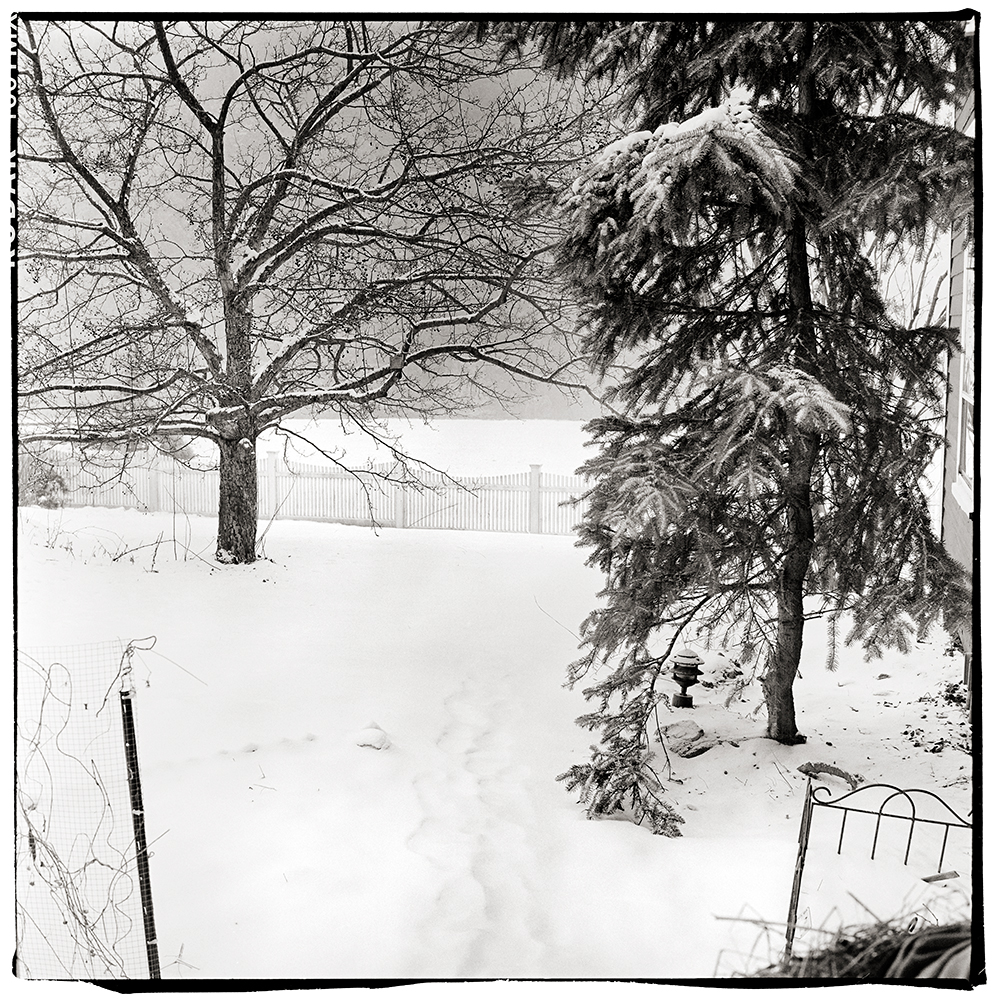

 Wishing you and your family a safe holiday season with lots of film based photography…