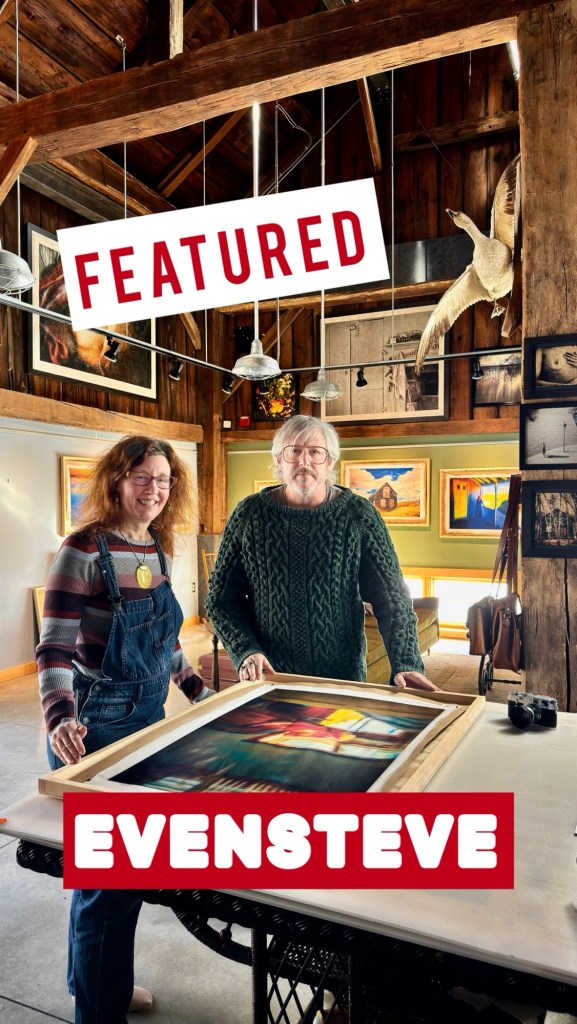
Pawlet-based artists EveNSteve are excited to announce open studio hours on Halloween weekend, Saturday Nov. 1, from 2 to 4 PM.
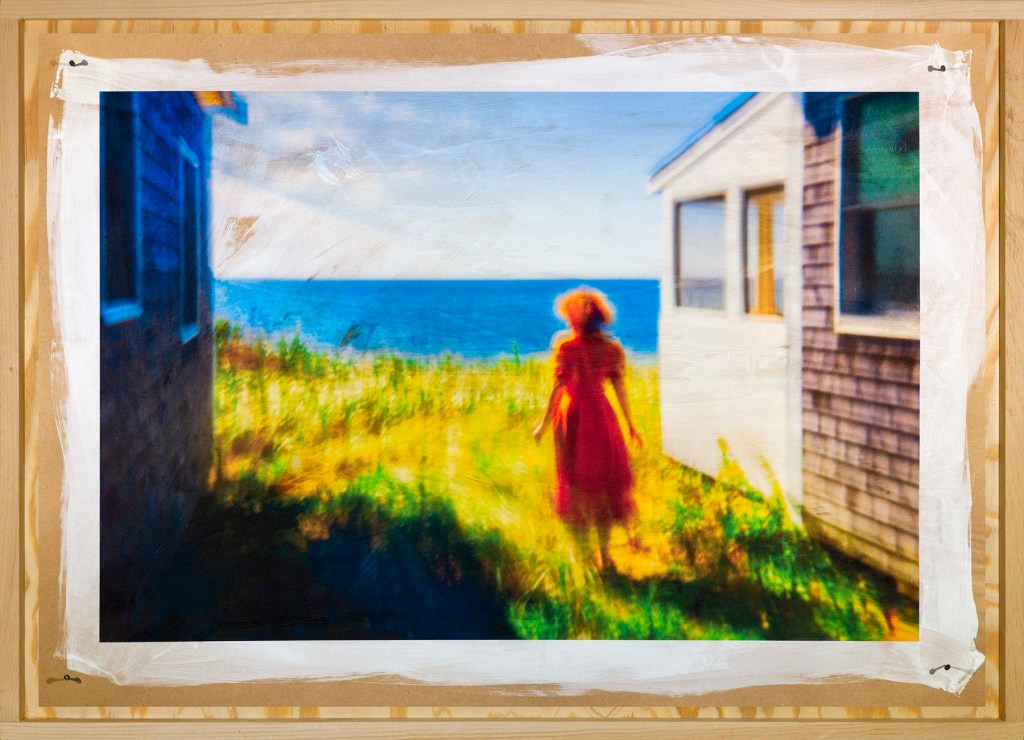
On display will be our two most recent bodies of work. The first portfolio, “The Nothing There Is,” uses black and white imagery with cryptic symbology. Several of the works in the series are featured in the current issue of Art New England Magazine. The second portfolio is a new unnamed body of work that celebrates vibrant color and unusual voices.
EveNSteve is the creative team of artist Stephen Schaub and author Eve O. Schaub. Their artworks combine imagery with handwritten text to create evocative landscapes that tell stories and speak to history. They also create award-winning experimental short films detailing their artworks and their art-making process.
EveNSteve’s studio is located at 671 River Road in Pawlet Vermont. To learn more visit EveNSteve.com or @EveNSteveartists on IG.
As we move through 2025 and inch closer to 2026, I think it’s more important than ever to embrace the physical nature of making and sharing art.
Why? Because the digital world is louder than ever. With the rapid rise of AI-generated content and the constant noise of the internet, standing out online is becoming a serious challenge. That’s why I believe the future of being a visible, sustainable artist will hinge on having something people can actually touch—whether it’s a print, a zine, a magazine, or a book.
In my latest video, I talked about why I’m leaning into magazines over books right now. The reason is simple: they’re cheaper to produce, and that means more people can see the work. A well-designed magazine—focused on a micro-project or a short series—lets you move fast, experiment, and share in a tangible way, without the pressure or cost of producing a high-end art book.
That’s not to say I’m against books (I love them, and I’m working on one). But there’s power in the immediacy and accessibility of smaller, physical projects. These formats allow artists to grow by seeing their work in a new light, and give clients, collectors, and friends a way to engage with the work beyond the scroll.
We’re at a moment where physical presence matters. If you want to survive as an artist in the years to come, give people something they can hold.
As we move through 2025 and inch closer to 2026, I think it’s more important than ever to embrace the physical nature of making and sharing art.
Why? Because the digital world is louder than ever. With the rapid rise of AI-generated content and the constant noise of the internet, standing out online is becoming a serious challenge. That’s why I believe the future of being a visible, sustainable artist will hinge on having something people can actually touch—whether it’s a print, a zine, a magazine, or a book.
In my latest video, I talked about why I’m leaning into magazines over books right now. The reason is simple: they’re cheaper to produce, and that means more people can see the work. A well-designed magazine—focused on a micro-project or a short series—lets you move fast, experiment, and share in a tangible way, without the pressure or cost of producing a high-end art book.
That’s not to say I’m against books (I love them, and I’m working on one). But there’s power in the immediacy and accessibility of smaller, physical projects. These formats allow artists to grow by seeing their work in a new light, and give clients, collectors, and friends a way to engage with the work beyond the scroll.
We’re at a moment where physical presence matters. If you want to survive as an artist in the years to come, give people something they can hold.
Are Modern Digital Cameras Too Sharp to Look Like Film?
Over the past few days, I’ve been conducting a test that has left me genuinely shaken—and deeply curious about the direction of photography in 2025.
I’ve been comparing three cameras: the Leica M11-P, the Ricoh GR III, and the Ricoh GRD IV from 2011 (with its legendary 10MP CCD sensor). Alongside them, I’ve been looking at good old Kodak Tri-X 400 processed in D-76 1:1. And here’s what I’ve found: replicating the look and feel of film—especially something as iconic as Tri-X—is nearly impossible with today’s top-tier digital cameras. Why? Because they’re simply too good with regards to resolution.
Let me explain.
When you shoot with the Leica M11-P, what you get is an image that’s almost unnervingly sharp. The micro-detail and micro-contrast are off the charts. It doesn’t matter what lens you put on it—it cuts through the scene with clinical precision. And while that’s technically impressive, it’s also the very thing that makes it difficult to achieve that classic filmic feel. The images are so sharp, so “perfect,” that no amount of digital grain or post-processing seems to bring them back into the aesthetic world of analog film.
Even the Ricoh GR III, with its 24MP APS-C CMOS sensor (no AA filter), delivers an image so crisp and contrasty that it almost feels too clean. It’s beautiful, yes—but unsettling. It’s not just detail; it’s hyper-detail. The images feel… louder than life. And maybe that’s part of the problem.
In contrast, the GRD IV from 2011—only 10MP and CCD-based—has an elegance that feels closer to film. There’s a softness, a gentler falloff in the tones. And, of course, real Tri-X has a depth, an irregularity, and a humanity that no software seems able to mimic convincingly.
This brings me to a larger question: Has our visual aesthetic as a culture changed?
We know film photography has seen a resurgence over the past five or six years, but in the grand scheme, it’s still a tiny sliver of the overall photo market. Digital dominates. And yet, many of today’s digital tools and presets aim to emulate film—but they can’t fully hide the fact that the underlying image is just too sharp. Most emulation software simply overlays grain onto a razor-sharp digital file. It feels fake. It looks fake. And we can see that it’s fake.
That’s why I turned to Real Grain 3 by Imagenomic for this test. It was the only software I found that actually reduced structural detail in the digital file in a meaningful way before applying the grain. It felt closer to the real thing—not perfect, but better. Because true film isn’t just about grain—it’s about the relationship between grain, light, focus, and depth. It’s about imperfection.
I don’t know what this all means just yet. I’m still processing (pun intended). But what I do know is that we’re living in a time where cameras are producing images so sharp, so clinically perfect, that it may be time to ask: Is this the look we want for photography going forward?
Or is there a growing desire—conscious or not—for images that feel less precise and more emotional?
The masters—Koudelka, Cartier-Bresson, early Salgado—shot on film. Their images breathe. They have edges that aren’t always sharp. Grain that adds to the story. I worry that we’re losing that sensibility in favor of sheer technical brilliance.
This is just me thinking aloud, but maybe it’s something we all should sit with.
Lately, I’ve been thinking a lot about the way we see—and how much information we actually need to perceive the world in a deeply human way. There’s a point at which resolution becomes not only unnecessary, but counterproductive. When we enter the realm of 4K, 8K, even 12K projections/ TV’s, something begins to feel off. The image is technically stunning, yes—but emotionally sterile. That hyper-clarity, like the hyper-smoothness of 60 or 120 frames per second (HFR) in video, may work for video games, but in cinema it often feels jarring, even unpleasant. It’s no accident that 24 frames per second still feels the most natural to our eyes—it has a rhythm that mirrors the way we actually experience motion.
Whenever I walk into a store and see the latest ultra-high-definition TVs, I’ll admit—I’m impressed for the first few seconds. But soon after, I find it overwhelming. There’s too much contrast, too much edge clarity, too much information bombarding my eyes. It stops being pleasurable. I find myself drawn instead to projection screens, where the light is reflected rather than emitted, or to older formats like 1080p, which feel more organic. In fact, we no longer even have a television in our home. When we did, I deliberately avoided buying a 4K set for precisely this reason—it just didn’t feel right.
This experience ties directly into how I think about photography. For years, the photo industry has been pushing the idea that “more megapixels equals better images.” But in my view, once you move beyond 18 or 24 megapixels—especially on full-frame 35mm sensors—the results often feel too sharp, too clinical. The images don’t feel better. They feel harsher, and in many cases, less human. That’s why I keep advocating for cameras with lower resolution—whether they’re small-sensor CCDs or large-sensor cameras like the Leica SL2-S, which tops out at 24 megapixels.
To my eye, the Leics SL2-S or the newer SL3-S produces images that feel far more filmic than, say, the 60-megapixel Leica M11-P. The latter may be technically superior, but the former feels better—more atmospheric, more alive. But again, I have to ask: in 2025, does “film-like” still matter? For those of us who lived and worked through the film era—who spent time in darkrooms, making prints by hand—it means something. But for younger photographers raised entirely in the digital realm, their visual reference point is different. The razor-sharp, hyper-detailed digital aesthetic may be what feels natural to them.
Still, I believe we’ve reached a kind of saturation point—a “peak resolution” moment. The photography industry, like many others, has long thrived on planned obsolescence. Resolution has been an easy metric to sell: higher numbers = better product. But I think that spell is finally breaking. You can see it in the analog resurgence: people are craving imperfection again. They’re seeking texture, atmosphere, and soul—qualities that can’t be measured in pixels.
After all, what has been one of the most beloved movements in the history of painting? Impressionism. Not because it rendered every detail with precision, but because it gave you just enough to feel something real—and let your heart and imagination do the rest. That’s what film, and lower-resolution analog mediums, do so beautifully. They don’t overwhelm you with data. They invite you into an experience. Not perfection—humanity.